



- Concord Campus - (925) 687-9555
- Fresno Campus - (559) 222-1903
- Modesto Campus - (209) 521-1821
- Sacramento Campus - (916) 588-2060
- San Jose Campus - (408) 384-7050
- Van Nuys Campus - (747) 200-4567
Overview
Below are the general education and core course titles and descriptions for the A.S. in Physical Therapist Assistant (PTA) program.
GE 020A - Human Body in Health and Disease I with Lab
75 Clock Hours/6 Quarter Credit Hours
Prerequisites: None
This is the first of two courses covering the structure and function of human organ systems. The basics of the structures and functions of the human body will be discussed during the lecture and lab. Between GE 020A and GE 020B, topics on all major organ systems will be examined while considering them in the state of health versus the state of disease.
This is a General Education Course.
GE 020B - Human Body in Health and Disease II with Lab
75 Clock Hours/6 Quarter Credit Hours
Prerequisites: Completion of GE 020A with a “C” or better.
This is the second of two courses covering the structure and function of human organ systems. The basics of the structures and functions of the human body will be discussed during the lecture and lab. Between GE 020A and GE 020B, topics on all major organ systems will be examined while considering them in the state of health versus the state of disease.
This is a General Education Course.
GE 103 - Growth and Development Through Lifespan
45 Clock Hours/4.5 Quarter Credit Hours
Prerequisites: None
This course discusses the existing growth and development theories. It focuses on understanding the dynamic sequence of biological, psychological, and sociological changes that occur through the life cycle from birth to death.
This is a General Education Course.
GE 112 - Algebra I
45 Clock Hours/4.5 Quarter Credit Hours
Prerequisites: None
This course gives students the math skills that provide a foundation for more advanced courses. Students will explore writing and solving linear and nonlinear equations, powers and exponents, quadratic equations, polynomials and factoring, graphing, and solving linear inequalities and functions.
This is a General Education Course.
GE 201 - Introduction to Sociology
45 Clock Hours/4.5 Quarter Credit Hours
Prerequisites: None
This course studies basic methods and concepts of sociology, which have broad academic relevance and can be applied to studying sociology and other academic disciplines.
This is a General Education Course.
GE 202 - General Psychology
45 Clock Hours/4.5 Quarter Credit Hours
Prerequisites: None
This course includes studying basic methods and concepts of psychology, which have broad academic relevance and can be applied to studying psychology and other academic disciplines.
This is a General Education Course.
GE 221 - Written Communication for Professionals
45 Clock Hours/4.5 Quarter Credit Hours
Prerequisites: None
The ability to write clearly and effectively is key to professional communication. This skill should not be limited to journalists or professional authors. This course will discuss overcoming common mistakes and improving communication using the written word.
This writing skill course includes spelling, grammar, the importance of structure, and formal and informal writing styles. This course also covers the skills needed to enable learning, communication of ideas, and understanding the ideas of others more effectively.
This is a General Education course.
GE 230 - Written & Oral Communication
45 Clock Hours/4.5 Quarter Credit Hours
Prerequisites: None
This course will explore the fundamental analog and digital skills of oral and written communication to help create professional written and oral communication within their careers. This is an introduction to various methods used to communicate effectively and create a language that articulates information to connect a speaker to an audience.
This is a General Education Course.
PTA 100 - Introduction to Physical Therapist Assistant
40 Clock Hours/4 Quarter Credit Hours
Prerequisites: None
This course introduces the Physical Therapist Assistant’s role and scope of practice. Emphasis will be placed on educational preparation, a historical overview of physical therapy in the healthcare system, professional affiliations, the structure and function of physical therapy services, ethical and legal issues in healthcare, documentation, and communication. This course also includes a self-study program in medical terminology and HIPAA regulations training.
PTA 110 - Fundamental PTA Procedures with Lab
77 Clock Hours/4 Quarter Credit Hours
Prerequisites: None
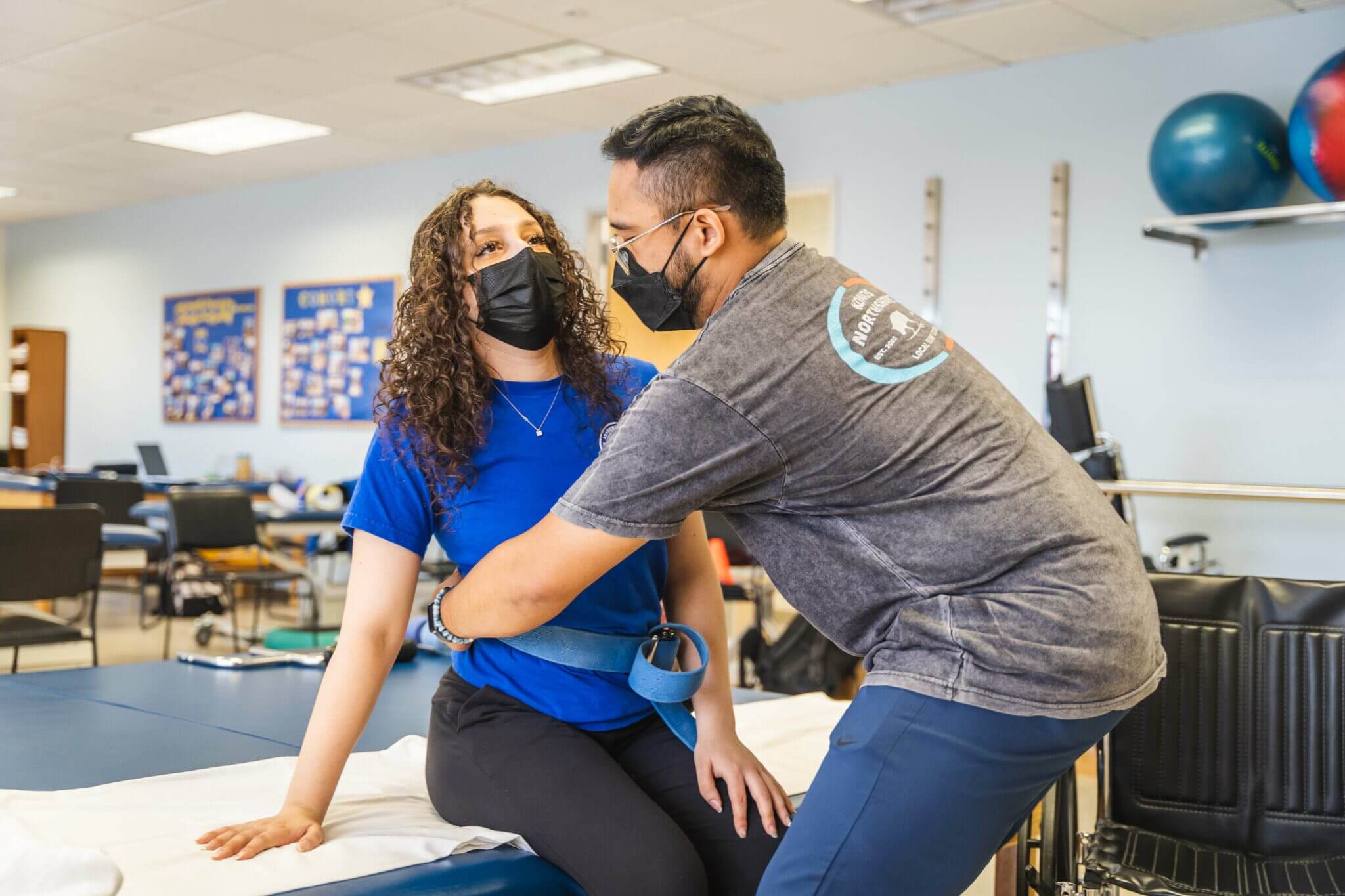
This course emphasizes safe, evidence-informed, and patient-centered care through a combination of hands-on laboratory experiences, guided practice, and structured reflection. Students will develop core competencies in infection control, vital signs assessment, body mechanics, bed mobility, transfers, wheelchair mobility, assistive device fitting, gait training, documentation, and professional behaviors.
PTA 120A - Clinical Kinesiology with Lab 1
54 Clock Hours/3.5 Quarter Credit Hours
Prerequisites: None
This course provides knowledge of the principles of mechanics and musculoskeletal anatomy and how they relate to human motion and the field of physical therapy. The concepts of locomotion, forces, and levers are introduced. Topics include muscle origins, insertions, and actions.
Laboratory experiences correlate to the lectures and include manual muscle testing and goniometry. Students will be expected to achieve competency on a given list of skills. Part 1 covers the lower extremity. Part II covers the upper extremity. This course is aligned by a body system with PTA 220.
PTA 120B - Clinical Kinesiology with Lab 2
32 Clock Hours/2 Quarter Credit Hours
Prerequisites: Completion of Term 3 with “C” or better.
This course provides knowledge of the principles of mechanics and musculoskeletal anatomy and how they relate to human motion and the field of physical therapy. The concepts of locomotion, forces, and levers are introduced. Topics include muscle origins, insertions, and actions.
Laboratory experiences correlate to the lectures and include manual muscle testing and goniometry. Students will be expected to achieve competency on a given list of skills. Part 1 covers the lower extremity. Part II covers the upper extremity. This course is aligned by a body system with PTA 220.
PTA 130 - Pathology
58 Clock Hours/5.5 Quarter Credit Hours
Prerequisites: None
Co-requisites: TA 100, PTA 110, PTA 120, PTA 220
This course provides knowledge of disease processes, systemic disorders, guidelines, precautions, and contraindications for physical therapy interventions.
PTA 210 - Procedures II with Lab
66 Clock Hours/4 Quarter Credit Hours
Prerequisites: Completion of Term 3 with “C” or better
This course introduces using and applying physical agents, soft tissue interventions, and electrotherapies in physical therapy. The practice of treatment techniques is emphasized through laboratory time. Students will be expected to achieve competency on a given list of skills.
PTA 220A - Orthopedic Management and Related Therapeutic Exercise 1
48 Clock Hours/3 Quarter Credit Hours
Prerequisites: Completion of Term 2 with “C” or better
Co-requisites: PTA 100, PTA 110, PTA 130, PTA 210, PTA 120A, PTA 222, PTA 230
This course provides an introduction to orthopedic-related conditions commonly seen in Physical Therapy. Basic exercise principles and their application are covered with laboratory discussion, demonstration, and practice. Students will be expected to achieve competency on a given list of skills. Part 1 covers the lower extremity, and Part II covers the upper extremity. This course is aligned by a body system with PTA 120.
PTA 220B - Orthopedic Management and Related Therapeutic Exercise 2
24 Clock Hours/1.5 Quarter Credit Hours
Prerequisites: Completion of Term 3 with “C” or better
This course provides an introduction to orthopedic-related conditions commonly seen in Physical Therapy. Basic exercise principles and their application are covered with laboratory discussion, demonstration, and practice. Students will be expected to achieve competency on a given list of skills. Part 1 covers the lower extremity, and Part II covers the upper extremity. This course is aligned by a body system with PTA 120..
PTA 222 - Patient Care Skills I
22 Clock Hours/1 Quarter Credit Hour
Prerequisites: Completion of Term 3 with a grade of “C” or better.
This lab course emphasizes the practical combination of patient pathologies covered in concurrent and previous courses. Students develop interventions from case scenarios and plans of care. Group participation and student-to-student assistance fostering communication and independence are encouraged to prepare for the clinical experience.
Students develop clinical problem-solving skills in orthopedic conditions, modalities, patient handling, therapeutic exercise, and presented pathologies. Students will be expected to achieve competency on a given list of skills.
PTA 225 - Clinical Education I
184 Clock Hours/6 Quarter Credit Hours
Prerequisites: Completion of Term 4 didactic coursework with a “C” or better.
This is the first integrated clinical experience designed to allow the student to further their exposure to physical therapy practice in the clinical environment and apply those skills that the student has tested proficiency in before the clinical experience and that the Clinical Instructor deems appropriate. Students will be at the clinical facility full-time for four (4) weeks and three (3) days.
PTA 230 - Professional Behaviors
33 Clock Hours/3 Quarter Credit Hours
Prerequisites: Completion of Term 3 with “C” or better.
This course introduces the concept of a multicultural society and how it plays an increased role in the physical therapy clinic. Topics include cross-cultural communication skills, the psychology of disability, health disparities between populations, age differences, ethics, values, and professional development within the healthcare system.
PTA 233 – Patient Care Skills II
22 Clock Hours/1 Quarter Credit Hour
Prerequisites: Completion of PTA 226 with “C” or better.
This lab course addresses the more complex patient. Case scenarios develop problem-solving skills in applying interventions following the supervising physical therapist’s Plan of Care. Concentration is on the progression and regression of exercises in response to patient performance.
Case studies will demonstrate the PT/PTA relationship and the PTA’s responsibility for the Plan of Care. Group participation and student-to-student assistance fostering communication and independence are encouraged to prepare for the clinical experience.
PTA 235 - Clinical Education II
240 Clock Hours/8 Quarter Credit Hours
Prerequisites: Completion of Term 5 didactic coursework with a “C” or better
This is the second integrated clinical experience designed to allow the student to further their exposure to physical therapy practice in the clinical environment and apply those skills that the student has tested proficiency in before the clinical experience and that the Clinical Instructor deems appropriate. Students will be at the clinical facility full-time for six (6) weeks.
PTA 240 - Applied Neurology
66 Clock Hours/4 Quarter Credit Hours
Prerequisites: Completion of PTA 226 with “C” or better.
This course builds on neurologically based disabilities commonly seen in physical therapy practice across the lifespan. Common therapeutic interventions for rehabilitation are practiced.
The chronic nature of neurologic conditions and their effect on the individual’s life will be addressed as they affect physical therapy. Students will be expected to achieve competency on a given list of skills.
PTA 245 - Clinical Education III
320 Clock Hours/10.5 Quarter Credit Hours
Prerequisites: Completion of PTA 100, PTA 110, PTA 120, PTA 130, PTA 210, PTA 220, PTA 230, PTA 222, PTA 225, PTA 240, PTA 250, PTA 260, PTA 233, PTA 235, PTA 280 with “C” or better.
This is the third and terminal clinical experience designed to allow the student to further their exposure to physical therapy practice in the clinical environment and apply those skills that the student has tested proficiency in before the clinical experience and that the Clinical Instructor deems appropriate. Students will be at the clinical facility full-time for eight (8) weeks.
PTA 250 - Physical Therapy Aspects of Growth, Development
44 Clock Hours/3 Quarter Credit Hours
Prerequisites: Completion of PTA 226 with “C” or better
This course covers relevant topics and interventions that deal with delivering physical therapy services across the lifespan, including the aging population as a normal process and the common pathologies associated with aging—emphasis on Cardiovascular and Respiratory conditions, fall prevention, and wound care.
PTA 260 - Selected Topics
44 Clock Hours/3 Quarter Credit Hours
Prerequisites: Completion of PTA 226 with “C” or better.
This course comprises selected physical therapy topics to complement prior coursework and required content in prosthetics and genitourinary conditions. Additional clinical topics may include vestibular, chronic pain, taping, ergonomics, and other contemporary issues encountered in physical therapy delivery systems.
PTA 280 - Senior Seminar
33 Clock Hours/3 Quarter Credit Hours
Prerequisites: Completion of PTA 235 with “Pass.”
This course brings full circle the educational and clinical experience for the PTA student. Each student will demonstrate the PTA as an educator by presenting a teaching unit related to an area of interest to prepare for the in-service required during the final clinical experience.
Students will explore the effective delivery of physical therapy services. Psychomotor, cognitive, affective, treatment approaches, communication, and documentation will be discussed regarding patient care.
Additional topics pertinent to an entry-level PTA will be presented. These include employment issues, continued professional development, the licensure application process, exam preparation strategies, and a review of California PT Practice Acts and Rules and Regulations.
PTA 290 - Licensure Exam Preparation
54 Clock Hours/5 Quarter Credit Hours
Prerequisites: Completion of PTA 100, PTA 110, PTA 120A, PTA 120B, PTA 130, PTA 210, PTA 220A, PTA 220B, PTA 230, PTA 222, PTA 225, PTA 226, PTA 240, PTA 250, PTA 260, PTA 233, PTA 235, PTA 236, PTA 245, PTA 280 with “C” or better.
This course is designed to review information and testing that will aid the student in preparation to take the NPTE for licensure as a PTA in California. A 16-hour workshop is facilitated by an outside educational company specializing in PTA exam preparation.
Have Questions? We are Here to Help!
Web Form
"*" indicates required fields
If you are a person who is deaf, hard of hearing, or speech-disabled, please Dial 711 to place a call through California Relay.