



- Concord Campus - (925) 687-9555
- Fresno Campus - (559) 222-1903
- Modesto Campus - (209) 521-1821
- Sacramento Campus - (916) 588-2060
- San Jose Campus - (408) 384-7050
- Van Nuys Campus - (747) 200-4567
Radiologic Technology Program - Track B
 24 Months Training*
 Associate Degree (A.S.)

-
 Approved by the CDPH-RHB
-
Accredited by JRCERT
-
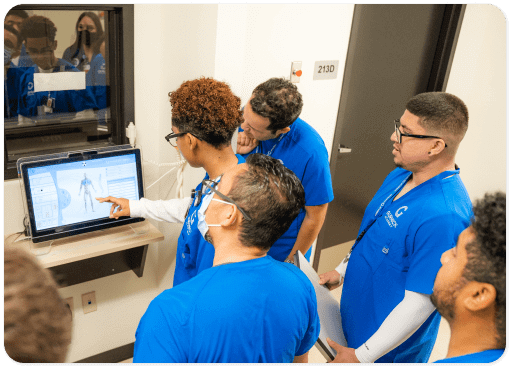
Hands-On Lab Training
-
Hands-On Lab Training
-
Job Placement Assistance


*96 Approved Instructional Weeks

Welcome to the Radiologic Technology – Track B program!
We are thrilled to embark on this journey with you as you pursue a career in radiologic technology. Our program will equip you with the knowledge, skills, and hands-on experience necessary to excel in this dynamic and rewarding field.
Throughout your time in the A.S. in RT – Track B program at Gurnick Academy, you will delve into various aspects of radiologic technology, including anatomy, physiology, radiographic procedures, patient care, and radiation safety. Our dedicated faculty members are here to support you every step of the way, offering guidance, mentorship, and expertise to help you succeed.

As you progress through the curriculum, you can apply what you have learned in real-world settings through clinical rotations at our partner healthcare facilities. These experiences will enhance your technical proficiency and cultivate your ability to work effectively as part of a healthcare team, providing compassionate patient care.
Pursuing a healthcare career requires dedication, hard work, and a genuine commitment to serving others. Rest assured, we are here to provide you with the tools and resources to thrive academically, professionally, and personally.

Congratulations on taking the first step toward a rewarding career in radiologic technology. We look forward to supporting you on your journey and celebrating your achievements.
Program Mission
The Associate of Science in Radiologic Technology – Track B program prepares students for employment as certified radiologic technologists.
The program emphasizes the knowledge, skills, and entry-level competencies required for examinations administered by the California Department of Public Health, Radiologic Health Branch, and the American Registry of Radiologic Technologists® (ARRT®).
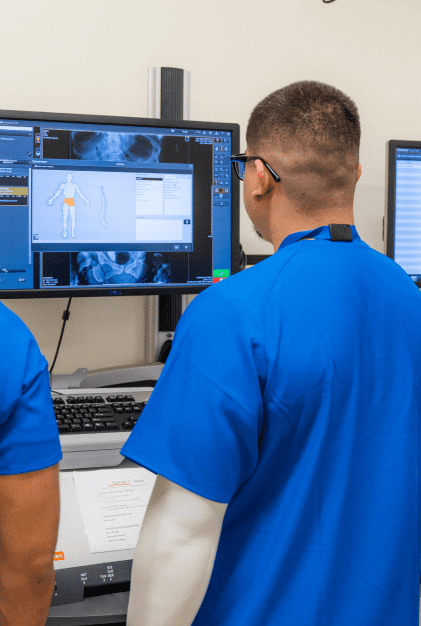
The Associate of Science Radiologic Technology – Track B program is committed to developing its students’ intellectual, analytical, and critical thinking skills, as well as their performance skills. Instructional methods based on established principles and practices of adult learning theory, combined with classroom techniques, encourage student participation.

Duties for program graduates may include performing diagnostic imaging procedures in hospital diagnostic imaging departments, surgical theaters, emergency rooms, doctors’ offices, and other healthcare settings, using both fixed and portable machines.
A felony conviction may affect a graduate’s ability to sit for certification examinations or attain state licensure. The individual student is responsible for understanding the certification requirements and state or national board licensing exams. Such stipulations may change during the program.

Students are responsible for inquiring with the appropriate agencies about current requirements before enrolling in the program, particularly if their circumstances change when applying for certification or licensure. Clinical sites may require criminal background checks or medical examinations.
Students learn about the requirements for employment and certification, as well as state board or national board licensing exams. No student automatically receives a certificate upon program completion. Students with felony convictions may not be eligible for certification.

This program prepares graduates to pursue entry-level employment in the field or related fields. These specific job titles may not correspond directly with the program title.
Although Gurnick Academy of Medical Arts will assist students with job placement, finding a job is their responsibility. The Institution does not guarantee student placement in any of the described occupations.
Some clinical rotations and radiographic examinations are deemed “gender-specific,” such as mammography and the hysterosalpingogram (HSG). While mammography is generally performed on females, the HSG is an examination conducted exclusively on female patients.

Male students should understand that they may not be required to observe or participate in these examinations due to their sensitivity. Didactic information on these examinations will be provided to all students. However, clinical experience may be limited to female students only.
- Students will use proper positioning skills.
- Students will obtain radiographs of acceptable diagnostic quality.
- Students will exercise proper radiation protection.

- Students will be able to modify standard procedures to accommodate non-routine patient conditions.
- Students will be able to critique images for diagnostic quality.
- Students will demonstrate effective oral and written communication skills.
The following is the most current program effectiveness data. Our programmatic accreditation agency, the Joint Review Committee on Education in Radiologic Technology (JRCERT), defines and publishes this information. Click here to visit the JRCERT webpage directly.

Credentialing Examination
The number of students who pass, on the first attempt, the registry certification examination in radiography or an unrestricted state licensing examination, compared with the number of graduates who take the examination within six months of graduation. The five-year average benchmark established by JRCERT is 75%.
| Credentialing Examination Rate Van Nuys Campus (Year) | Number Passed on 1st Attempt Divided by Number Attempted Within Six (6) Months of Graduation (Results) |
|---|---|
| 2021 | 23 of 23 - 100% |
| 2022 | 19 of 22 - 86% |
| 2023 | 46 of 49 - 94% |
| 2024 | 37 of 43 - 86% |
| 2025 | 51 of 54 - 94% |
| Program 5-Year Average | 176 of 191 - 92.1% |

Job Placement
The number of graduates employed in the radiologic sciences compared to those actively seeking radiologic sciences employment within 12 months of graduating. The five-year average benchmark established by JRCERT is 75%.
| Job Placement Rate Van Nuys Campus (Year) | Number Employed Divided by Number Actively Seeking Employment* within 12 Months of Graduation (Results) |
|---|---|
| 2020 | 6 of 10 - 60% |
| 2021 | 20 of 20 - 100% |
| 2022 | 39 of 46 - 85% |
| 2023 | 46 of 49 - 94% |
| 2024 | 37 of 37 - 100% |
| Program 5-Year Average | 148 of 162 - 91.4% |
*“Not Actively Seeking Employment” is defined as:
1) Graduates fail to communicate with program officials regarding employment status after multiple attempts;
2) Graduates are unwilling to seek employment that requires relocation;
3) Graduates are unwilling to accept employment due to salary or hours;
4) Graduates are on active military duty; OR
5) Graduates are continuing their education.

Program Completion
The number of students who complete the program within the stated program length. The program’s annual benchmark is 80%.
| Program Completion Rate Van Nuys Campus (Year) | Number Graduated Divided by Number Started the Program (Results) |
|---|---|
| Year - 2024 | 43 of 52 - 82.7% |
| Annual Completion Rate | 82.7% |
*96 Approved instruction Weeks
The program information, length, and schedule are subject to change. Please read the Catalog & Addendum for changes and updates. Furthermore, schedule a check-in with the Admission Advisor for details.
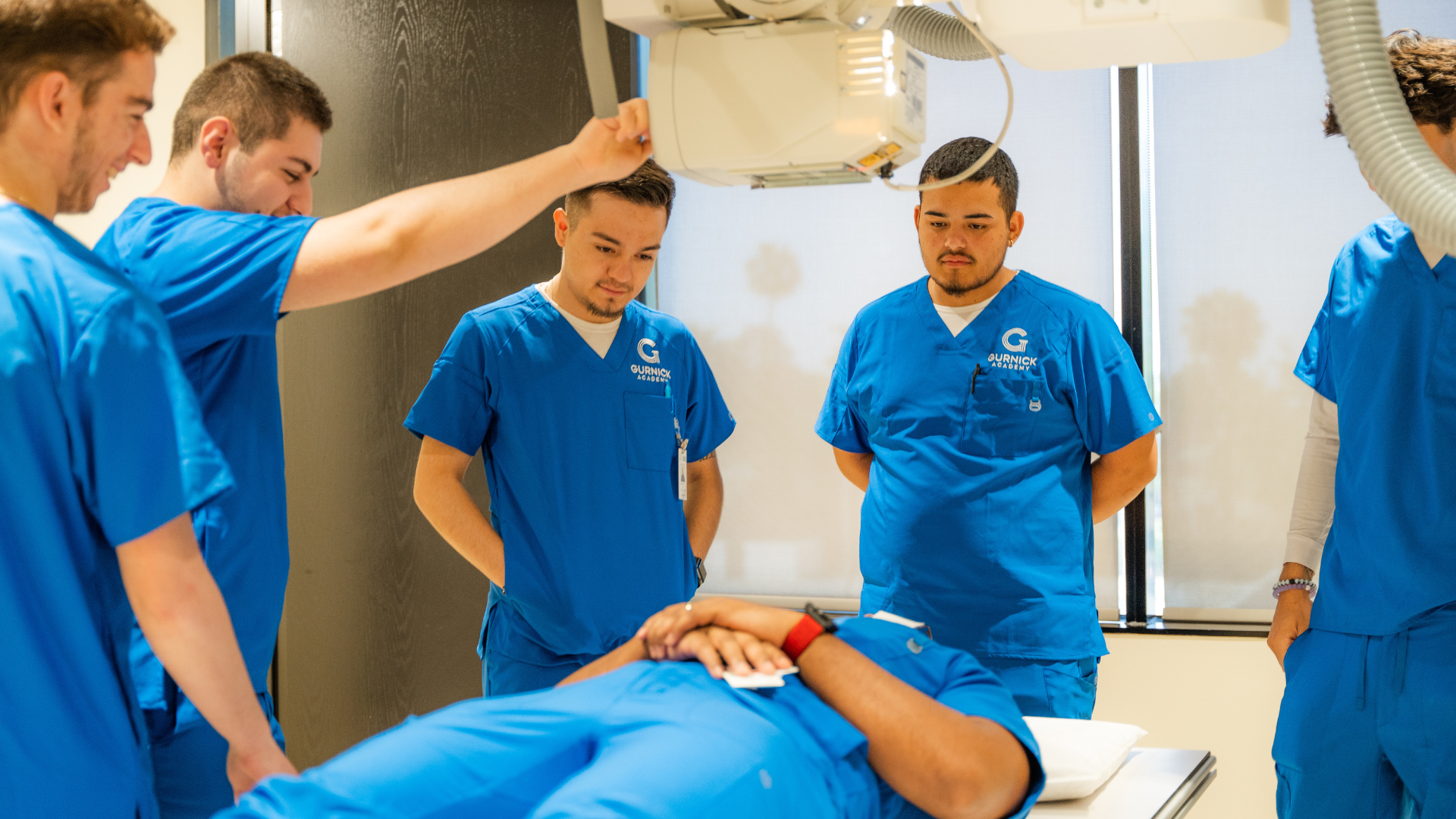
The A.S. in Radiologic Technology – Track B program offers a library and classrooms equipped with modern media teaching aids, textbooks, journals, periodicals, anatomical charts, phantoms, and energized laboratory equipment.

The Associate of Science in Radiologic Technology – Track B program consists of 135 quarter credit hours completed over 96 weeks for day and night students, for 2,449 contact hours. Before graduation, students must complete 1,504 hours of clinical practice.
Depending on the designated program track, didactic courses are scheduled during the day or evening. The spring start each year has classes Monday through Friday with a 5:30pm start; whereas the fall start each year has classes Monday through Friday with an 8 am start. Both spring and fall start use the same curriculum and course sequence. Students can expect to engage in approximately 40 hours of instruction per week, which includes didactic coursework, laboratory sessions, and clinical training.

Lectures are provided in-person on campus and via a synchronous online format where students and instructors interact in real time, participating in a digital classroom – such as Zoom or Google Meet. All labs and exams will occur on campus, whereas within multiple quarters of the program approximately one course will be taught in a synchronous format, based on instructor availability.
Applicants are evaluated using a point-based admissions system. Only the first 150 applicants who submit all required admission documents and pay the registration fee will be considered for further review. From this group, applicants will be ranked based on their admission points. Only the highest-scoring applicants will be selected to participate in the interview process.

Following the interview, applicants will be evaluated based on their overall score, and those with the highest scores, above the minimum required threshold, will be offered seats in the program. The point system below identifies the admission criteria and the maximum points available.
| A.S. in Radiologic Technology - Track B Program | Points Possible |
|---|---|
| I. CCAT | 50 |
| II. Credit Granted Courses | 130 |
| ➢ Algebra | 30 |
| ➢ Anatomy | 30 |
| ➢ Physiology | 30 |
| ➢ Critical Thinking | 10 |
| ➢ English Reading and Composition | 10 |
| ➢ Sociology | 10 |
| ➢ Medical Terminology | 10 |
| III. Post-Secondary Education | 50 |
| ➢ Associate Degree | 25 |
| ➢ Bachelor’s Degree | 50 |
| IV. One-Page Resume | 10 |
| V. Essay - One-Page, APA Format | 10 |
| The essay will include: | |
| ➢ Statement of Why You Would Like to Join This Modality | |
| ➢ The Essential Functions and Role of a Technologist in This Field | |
| ➢ Preparation to Become Successful in This Program | |
| ➢ APA Title Page and Sources Used to Prepare for the Essay (Title page and sources can be on a separate page) |
|
| VI. Healthcare Background | 90 |
| ➢ One to Three (1-3) Years | 20 |
| ➢ More Than Three (3) Years | 30 |
| ➢ Radiology Community Involvement | 30 |
| Radiology Community Involvement consists of volunteering in an imaging department, attending a conference in Radiology, or a Career Discussion Panel. A certificate of attendance that is signed and dated will be required for points from Human Resources or a sanctioned event. Every eight hours of documented volunteer time in an imaging department or conference is worth ten (10) points, with a maximum of 30 points. | |
| ➢ Current State of California Limited Permit (License) in Chest, Extremities, and Torso Skeletal | 30 |
| VII. Personal Interview | 120 |
| ➢ Professionalism | |
| ➢ Communication | |
| ➢ Motivation | |
| ➢ Overall Impression | |
| Total Points Possible | 460 |






Gurnick Academy of Medical Arts considers clinical experience essential in healthcare education.

Students must rotate throughout our affiliated medical facilities while attending our Associate of Science in Radiologic Technology – Track B program.
View the O*Net Online 29-2034.00 Radiologic Technologists and Technicians job profile for general information about the profession. Find salary data for California and the major cities near the campus where the program is offered.

Gurnick Academy of Medical Arts holds national institutional accreditation by the Accrediting Bureau of Health Education Schools (ABHES). ABHES accreditation does not include continuing education courses.
ABHES Mailing Address:
6116 Executive Blvd., Suite 730
North Bethesda, MD 20852
ABHES Phone: 301-291-7550
ABHES Email: Info
ABHES Website: abhes.org

Gurnick Academy of Medical Arts is a private institution approved to operate by the California Bureau for Private Postsecondary Education. Approval to operate means the institution is compliant with the minimum standards in the California Private Postsecondary Education Act (CPPEA) of 2009 (as amended) and Division 7.5 of Title 5 of the California Code of Regulations. CPPEA governs the Bureau for Private Postsecondary Education.
The Office of Student Assistance and Relief is available to support prospective students, current students, or past students of private postsecondary educational institutions in making informed decisions, understanding their rights, and navigating available services and relief options. The office may be reached by calling (888) 370- 7589, option #5, or by visiting osar.bppe.ca.gov.
BPPE Mailing Address:
1747 N. Market Blvd., Suite 225
Sacramento, CA 95834
BPPE Phone: 888-370-7589
BPPE Email: General
BPPE Website: bppe.ca.gov

The California Department of Public Health, Radiologic Health Branch (CDPH-RHB) approves Gurnick Academy of Medical Arts for the A.S. in Radiologic Technology – Track B program.
CDPH-RBH Mailing Address:
P.O. Box 997377, MS 0500
Sacramento, CA 95899
CDPH-RBH Phone: 916-558-1784
CDPH-RHB Website: cdph.ca.gov

Gurnick Academy of Medical Arts is approved and accredited with the maximum earned award available by the Joint Review Committee on Education in Radiologic Technology (JRCERT) to provide the A.S. in Radiologic Technology – Track B program.
The program’s current award is 8 years. General program accreditation information and the current accreditation award letter can be found here: https://www.jrcert.org/programs/gurnick-academy-of-medical-arts-van-nuys/.
JRCERT Mailing Address:
20 North Wacker Drive, Suite 2850
Chicago, IL 60606
JRCERT Phone: 312-704-5300
JRCERT Email: Info
JRCERT Website: jrcert.org
For more information about the Licensure, Certification, and Registry Disclaimer, please refer to the school catalog.
Click here for license examination pass rates.

State Authorization
Gurnick Academy of Medical Arts provides information on whether its programs meet educational requirements for professional licensure or certification in each state. Students are encouraged to review the Curriculum and Licensure Requirements by State available on the Academy’s website here to determine if a specific program fulfills the requirements in their intended state of residence or employment.

Gurnick Academy of Medical Arts aims to help every student obtain Financial Aid* to attend their chosen program. Gurnick Academy of Medical Arts participates in various federal and state student financial assistance programs.
The financial aid programs are designed to assist students with inadequate financial resources to meet their education’s total cost. Each campus has a Financial Aid Advisor who can help students with any financial aid questions.
For more information, please visit our Financial Aid page.
*for those who qualify

Anna Nazarian
RT program
I faced numerous curveballs during my education, but I continued to push through. I ensured that I did everything I had to do to complete my work.
Likewise, I completed all the necessary tasks and continued to study to ensure I passed all my exams. The staff and instructors here at Gurnick have all been helpful and understanding.
If you are a person who is deaf, hard of hearing, or speech-disabled, please Dial 711 to place a call through California Relay.